Limited Edition, crazy expensive, and easily worth it. The second-generation, 2026 BMW M2 CS rockets down the road with purpose, engagement, and driving joy.
| What’s Good: Mega power from a smooth, twin-turbocharged, 3.0-liter inline-six. Fantastic handling, race car levels of support in the seats. | What Could Improve: Not for the faint of heart in the ride department. Six-figure price in a version of BMW’s smallest model. Automatic only. | My Conclusion: The M2 CS proves that BMW has still got it. This is the most fun I’d had in a car in years. All the elements combine to a fully immersive machine of delight. |
OVERVIEW
BMW recently launched the limited edition, 2026 BMW M2 CS. The ultra-high-performance version of the second-generation M2, which itself came to us in 2023. And it’s mega. You get more power, less weight, a lowered and stiffened suspension, carbon-fiber everything, and crap-tons of grip.
Of course, crap-tons don’t come cheap. BMW wants at least $99,950 for the base M2 CS. You spend an additional $29,400 when compared with a standard M2. Furthermore, my test car included no options—other than the $8500 ceramic brake kit—which brings the total to an eye-widening $108,450. Yeah, six-figures for the high-strung version of BMW’s least expensive car.
And it’s worth every penny.
powertrain
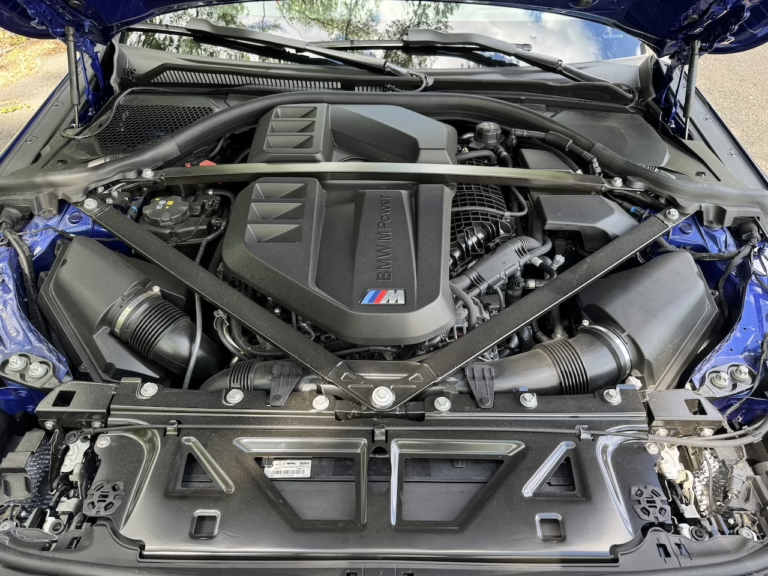
Under the hood lies, fundamentally speaking, the same S58, twin-turbocharged 3.0-liter inline-six engine as the regular M2. But engineers worked to eke out an additional 50 horsepower and 36 lb.-ft. Credit all that power to two-turbochargers each feeding three cylinders with additional air, an electronically controlled waste-gate, high-pressure fuel injection, and variable timing to make it all work. In total, you get 523 horsepower at 6250 rpm and 479 lb.-ft between 2750 – 5730 rpm. And, despite turbos, the engine will still crest 7000 revs. Redline hits at 7200 rpm.
Given the car’s 3770 lbs. curb weight, that gives you just 7.2 lbs./HP to haul around. Combined with an eight-speed automatic with incredibly sharp shifting capability and an M-differential getting power to the rear wheels, the M2 CS hustles to sixty mph from rest in just 3.7 seconds, courtesy of the built-in launch control system. That’s 0.2 seconds better than the standard M2. Keep your foot in it and the CS will eventually reach a Le Mans worthy 188 mph.

A moment on the automatic. Yes. The standard M2 offers a manual transmission. And, yes, in many ways that’s the preferable, more engaging driving experience. But this automatic offers three-levels of shift speed and the ability to have full gear control via paddle shifters. It will bounce off the rev limiter until you flick the paddle. And that box also allows launch control. So—yes—it’s a compromise. But also yes, a pretty darn good one.
Critically, it’s all plenty drivable. Power comes on rapidly, but linearly. And BMW tuned the throttle map to give you some pedal to work with to modulate as needed. In other words, you summon the power on your command, which makes it that much better.

chassis
At a glance, the specs say the M2 CS uses the most common suspension geometry of any modern car: struts up front and a multilink rear. It is a four-wheel independent suspension. But look closer and you notice that BMW uses a double-joint front suspension to more precisely articulate over pavement imperfections and improve steering response. And you see very elaborate use of aluminum links to lighten the unsprung load and make it all operate quickly.
From there, BMW lowers it by 0.2-in, compared to a standard M2 and stiffens up the springs, shocks (which are adaptive by the way), and anti-roll bars. You even get a different tune of ABS, traction, and stability control.

And then BMW went to town on weight. Engineers swapped in forged-aluminum alloy wheels—19-in in front, 20s in the rear—and used generous amounts of carbon fiber and CFRP (carbon fiber reinforced plastic) for the roof, sideview mirror covers, rear diffuser, trunk lid, and several parts of the interior. All that adds to 97 fewer pounds, when compared to the standard M2 equipped with the automatic.
Finishing all that off with fantastic Michelin Pilot Sport 4S, high-performance summer rubber, you get a car that holds the road with the ferocity of a cheetah on creatine and beta-alanine. The front-end responds immediately to your inputs and whips you toward the apex with massive force. Even with a heavy right foot, the rear-end holds and lays power down to rocket you off to the next corner. Stomp your foot and the rear-end will absolutely slide, but in an easy to control manner. Absurd cornering speeds at its finest. It’s addicting.

Inside
BMW wants you—and everyone else—to know it’s a CS. That’s why it says “M2 CS” on both the front and rear ends. It also says so on the door sill. As well as “CS” illuminated on the door, just beneath the headrest on the seat, and on the lower center console. Yeah, BMW, we know!
It’s also rather obvious from the carbon fiber steering wheel and lower center console; beautiful, but not subtle. Nor are the M bucket seats, replete with a removable headrest for helmet clearance. With race car worthy upper and lower bolsters, slots for a four-point harness, and even a hunk of carbon to separate the legs, they fit snug and feel fantastic on the road. Especially with adjustable upper bolsters squeezed tight. But you’ll feel every extra ounce of body fat on you every time you need to get out.

Moreover, the carbon wheel gets a lovely wrap of Alcantara synthetic suede to grip and includes an M1 and M2 button to quickly switch to your own customized “drive modes.” Strictly speaking, BMW did not develop drive modes, rather separate adjustments to the engine, transmission, exhaust, suspension, steering, even the brakes, to customize the feel of the car as you wish. I prefer this approach.
Being a modern car, you also get a 12.3-in digital instrument cluster, a 14.9-in center display, a head-up display, and generation 8.5 of BMW’s operating system. And that includes wireless Apple CarPlay and Android Auto connectivity. You also get a lovely Harman Kardon sound system. I never turned it on.
Conclusion
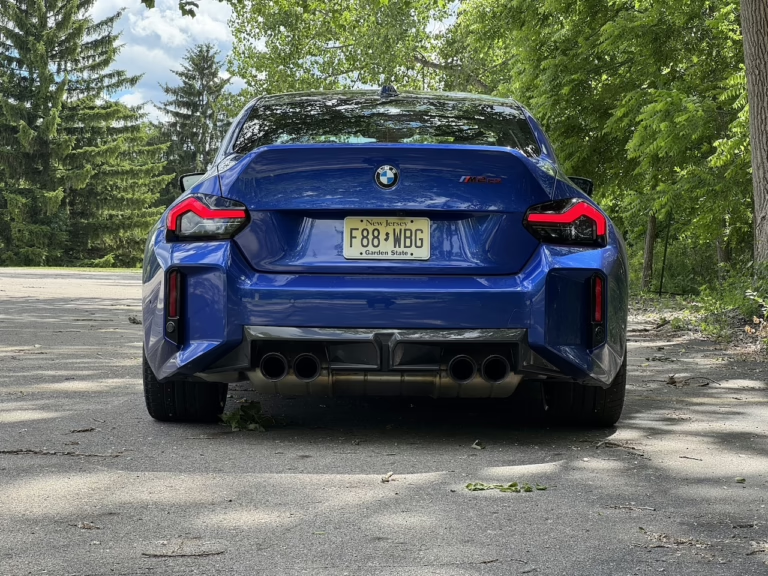
Altogether, the M2 CS looks stunning. It stands low, aggressive, and full-of-purpose at every angle. And despite the stratospheric capability, it’s easy to find and safely surpass the limit. The M2 CS looks intimidating, but drives intuitively. BMW doused it with that secret sauce of goodness that makes cars like this uniquely fun.
All told, the M2 CS is an absolute steal for any driving enthusiast.

Competitors
Audi RS 3
Chevrolet Corvette
Mercedes-AMG C63 S
Specifications
2026 BMW M2 CS: 2-door, 4-seat, coupe
Base price: $99,950 (includes $1350 destination charge)
Price as Tested: $108,450
Powertrain: Turbocharged 3.0-liter I-6
Peak power: 523 horsepower at 6250 rpm
Peak torque: 479 lb.-ft between 2750 – 5730 rpm
Transmission: eight-speed automatic transmission
Drive: rear-wheel-drive
Fuel Economy in MPG and range
16 city
23 highway
19 combined
Driving range: 260 miles
Dimensions
Length: 180.6/4587 in/mm
Width: 74.3/1887 in/mm
Height: 54.9/1394 in/mm
Wheelbase: 108.1/2746 in/mm
Weights and Capacities
Curb weight: 3770 lbs.
Interior volume: 88 cu ft (according to fueleconomy.gov)
Trunk volume: 10 cu ft (according to fueleconomy.gov)
Calculated weight to power (lbs./HP): 7.2:1
Mfr’s claimed 0-62 mph: 3.7 seconds
Mfr’s claimed Top Speed: 188 mph
Government classified size: subcompact car
Options: M Carbon ceramic brake – red, $8500